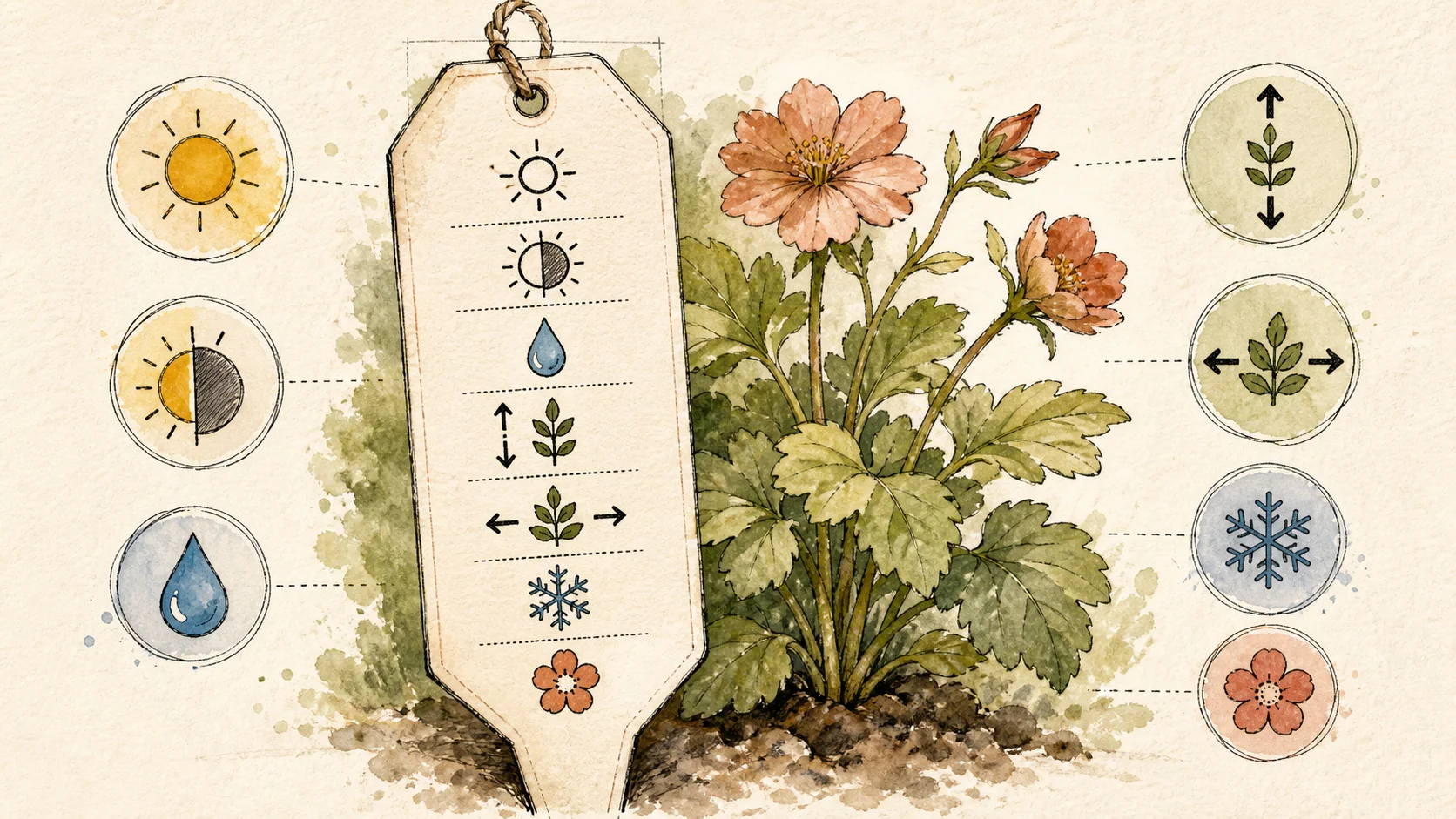
Plant-label symbols are compact shorthand for light, moisture, mature size, flowering season, and climate. They are not a universal code: use the label maker's printed legend, then confirm the icon with the words, numbers, and growing conditions on the same label.
If you only want the short answer to "what do the symbols on plant labels mean," here it is: a sun means light need, a drop means moisture need, arrows mean mature size, a snowflake or number means cold tolerance, and a flower means bloom time. The rest of this guide explains each one and the common variations you will meet at the nursery.
This guide covers both kinds of marker. A plant tag is the printed card or stake that comes with a plant from a retail nursery or garden center. A plant label is the marker you make or place yourself. The two often use the same symbols, so you can read either one the same way.
Looking for how to make your own labels? See How to Label Plants and the best way to label plants.
A quick plant symbol chart and legend
The chart and table below are an original reference, not a reproduction of a nursery's artwork or a third-party icon set. Different growers can draw the same idea differently, so treat them as a prompt for what to verify rather than as a replacement for the label's own key.
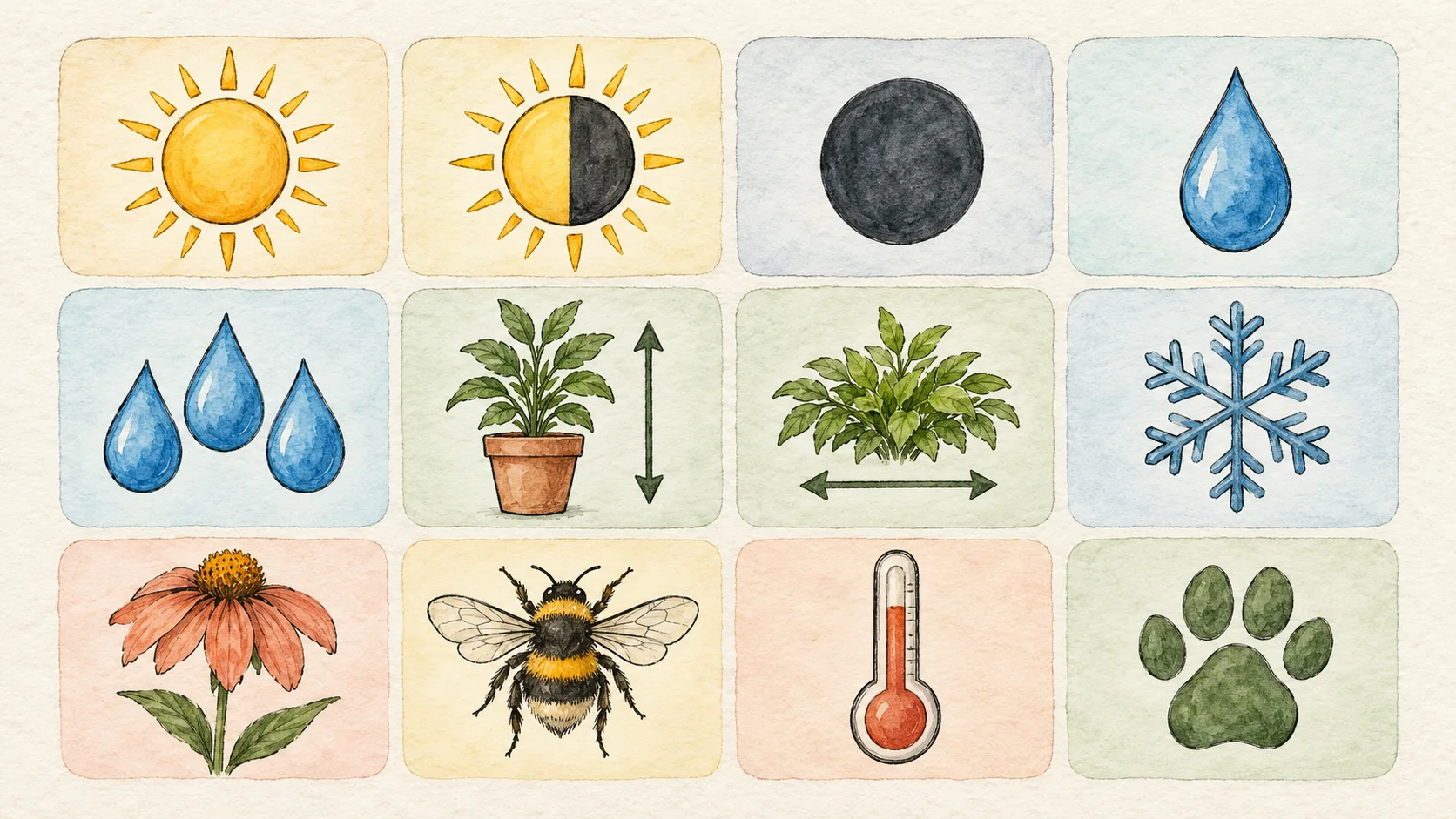
Common plant label and care icons, drawn for this guide. Left to right, top to bottom: full sun, part sun or part shade, full shade, low water, high water, mature height, mature spread, cold hardiness, bloom time, pollinator friendly, temperature, and pet safety. Real tags draw these differently, so check each tag's own legend.
| Symbol in this guide | Usually points to | Safe reading | Check before acting |
|---|---|---|---|
| ☀ | Full sun | The plant needs substantial direct light. Many US plant-label guides use at least six hours per day as the full-sun threshold. | Count direct light at the planting site, not just the bright light near a window. |
| ◐ | Part sun or part shade | The plant can handle an intermediate light range. | Look for the label's hours or wording; a half-sun drawing is not a universal measurement. |
| ☁ | Full shade or low direct light | The plant needs less direct sun than a full-sun plant. Full shade does not necessarily mean a completely dark location. | Check whether the label defines shade as filtered light, morning light, or a number of hours. |
| 💧 | Moisture or watering preference | The icon describes a relative moisture need, from lower to higher. | It is not a fixed watering schedule, and it does not measure soil moisture. |
| ↕ / ↔ | Mature height and spread | The arrows usually identify the space the plant may need at maturity. | Confirm the units, whether the numbers are height or width, and the expected growing conditions. |
| ❄ | Hardiness or cold tolerance | The mark points to a temperature range or hardiness-zone rating. | A zone describes typical climate limits; it is not a guarantee against frost, wind, wet soil, or an unusual season. |
| ✿ | Flowering time or seasonal interest | A month, season, or shaded calendar area usually indicates when flowers are expected. | Local climate, planting time, and the plant's maturity can change the actual season. |
The light definitions in the table follow the practical ranges described by University of California Agriculture and Natural Resources: full sun is at least six hours of direct sunlight, partial sun or shade is about three to six hours, and full shade is less than three hours. Commercial label makers can draw sun, water, arrow, and temperature icons differently, so no single vendor's artwork should be treated as an industry-wide standard.
Read the plant name before the care symbols
A care icon cannot correct a misidentified plant. Read both the common name and the botanical name, then check the cultivar or variety when one is listed. Oregon State University Extension's guide to plant labels explains why the botanical name and nursery abbreviations matter: similar common names can refer to different plants, while a scientific name gives you a more reliable starting point for further research.
If the photograph on the label does not match the plant in the pot, stop and ask the nursery to confirm the identification. University of California Agriculture and Natural Resources also recommends checking that the picture, flower color, and container belong together.
What the main symbol groups tell you
Light symbols: match the plant to the site
A sun, half-sun, or cloud mark is about the amount of direct light the plant is expected to receive. Observe the location at different times of day: a bed beside a wall, tree, or greenhouse can move from sun to shade as the season changes. The University of Maryland Extension's plant-tag guide explains that full sun, part sun or shade, and full shade are practical growing descriptions rather than decorative ratings.
Do not turn a light symbol into a promise about flower color, growth speed, or survival. It is one input in a planting decision, alongside soil, drainage, temperature, and the plant's maturity.
Water symbols: read a range, not a calendar
One or more drops can indicate a relative moisture preference, but the same number of drops may be used differently by different label designers. Prefer explicit words such as "low," "moderate," "moist," "well-drained," or "drought tolerant" when they are printed. Then consider rainfall, container size, soil, wind, and whether the plant is newly planted.
A water icon does not tell you that a plant needs water today. It also does not mean a digital Plant Record or a physical plant label can sense moisture automatically. If you keep a care history, record the watering entry you actually made rather than treating a symbol as a reminder.
Arrows and numbers: plan for mature size
An upward arrow often accompanies mature height, while a sideways arrow or a second number can describe mature spread. Write down the units before comparing plants: inches, feet, centimetres, and metres are not interchangeable. A small nursery container also does not represent the plant's final size.
Use the stated dimensions to decide spacing and placement, but treat them as an estimate for the stated conditions. Pruning, climate, soil, and container restrictions can change the result.
Snowflakes, thermometers, and zones: understand the climate system
A cold or snow symbol may point to a temperature range or a hardiness zone. The USDA Plant Hardiness Zone Map describes zones using average annual extreme minimum winter temperatures. That makes a zone useful for comparing a plant's typical cold tolerance with a location, but it does not account for every factor that affects survival.
Check which country's rating system the label uses. A zone number, a frost rating, and a local nursery's plain-language description may refer to related questions without being the same scale. If the plant is tender, use the label as a reason to research protection rather than as a guarantee.
Flowers, bees, and other marks: identify the claim
A flower, calendar, or shaded month area can describe bloom timing. Treat it as an expectation rather than a date: local climate, planting time, and the plant's maturity can shift the actual season.
A bee, butterfly, or hummingbird mark may communicate a pollinator-related feature. A native-plant or eco mark may signal a regional claim. These marks are claims about a plant or a grower's selection, not proof that every garden will see the same result. Look for the accompanying words, certification name, or source instead of relying on an isolated pictogram.
Plant care icons on houseplant tags
Houseplants often come with a care card instead of an outdoor nursery tag. These cards use many of the same light and water icons, and they add a few that matter mostly indoors.
| Icon | Usually points to | Safe reading | Check before acting |
|---|---|---|---|
| 🌡 | Temperature | On a houseplant card, a thermometer often shows a comfortable indoor temperature range. On an outdoor tag, it can point to cold hardiness instead. | Read the numbers and units next to the icon, and check whether the label means indoor comfort or outdoor survival. |
| 💨 | Humidity or misting | The plant prefers more humid air than a typical heated room. | It is a preference, not a misting schedule. Grouping plants or using a humidity tray can also raise local humidity. |
| 🌱+ | Feeding or fertilizer | The card suggests how often to feed during active growth. | Follow the fertilizer product's own directions, and reduce feeding when growth slows. |
| 🐾 | Pet safety | The card makes a claim about whether the plant is toxic to cats, dogs, or other pets. | Confirm the botanical name against a source such as the ASPCA toxic and non-toxic plant list. Contact a veterinarian if a pet eats a plant. |
A pet-safety icon is the one to verify most carefully. Common names can refer to different plants, and a care card may cover a whole plant family with one generic icon. Match the botanical name before you trust a "pet safe" mark.
Why the same symbol can mean different things
There is no single global dictionary for plant-label artwork. A partly shaded sun may mean part sun, part shade, or an intermediate light range; a drop may mean watering frequency, soil moisture, or a general moisture class. Retailers and growers also use different climate systems and units.
Use this order when an icon is unclear:
- Find the legend, small print, or care key on the reverse of the label.
- Read the words and numbers next to the icon.
- Identify the plant and cultivar so you can verify the advice from a horticultural source.
- Compare the guidance with your location, soil, container, and season.
- Ask the nursery or grower when the label still leaves a safety-critical question unanswered.
A five-step label check
- Confirm identity. Match the common name, botanical name, cultivar, and photograph.
- Check light. Compare the label's sun or shade description with direct light at the actual planting spot.
- Check moisture and drainage. Use the water symbol as a relative cue, then read the written drainage advice.
- Reserve enough space. Record mature height and spread with their units before planting.
- Check climate limits. Compare the hardiness rating with a reliable local map and account for frost pockets, wind, wet soil, and seasonal variation.
What plant-label symbols cannot tell you
Symbols are useful summaries, but they cannot identify every microclimate or replace observation. They do not provide a guaranteed watering frequency, diagnose disease, measure soil moisture, promise a bloom date, or prove that a plant will survive an exceptional weather event. They also do not replace a clear plant name when a label is moved or separated from its container.
If you are creating a physical plant label for a plant you already own, use a readable name and a consistent identifier first. You can keep longer care notes, growth updates, and Plant Photos in a record you maintain separately. For a practical naming and placement system, continue to How to Label Plants. For the best materials by garden scenario, read the best way to label plants; for nursery-specific workflow, see how to label plants in a nursery.